Avoiding Bounce Storms with PowerMTA Backoff Rules
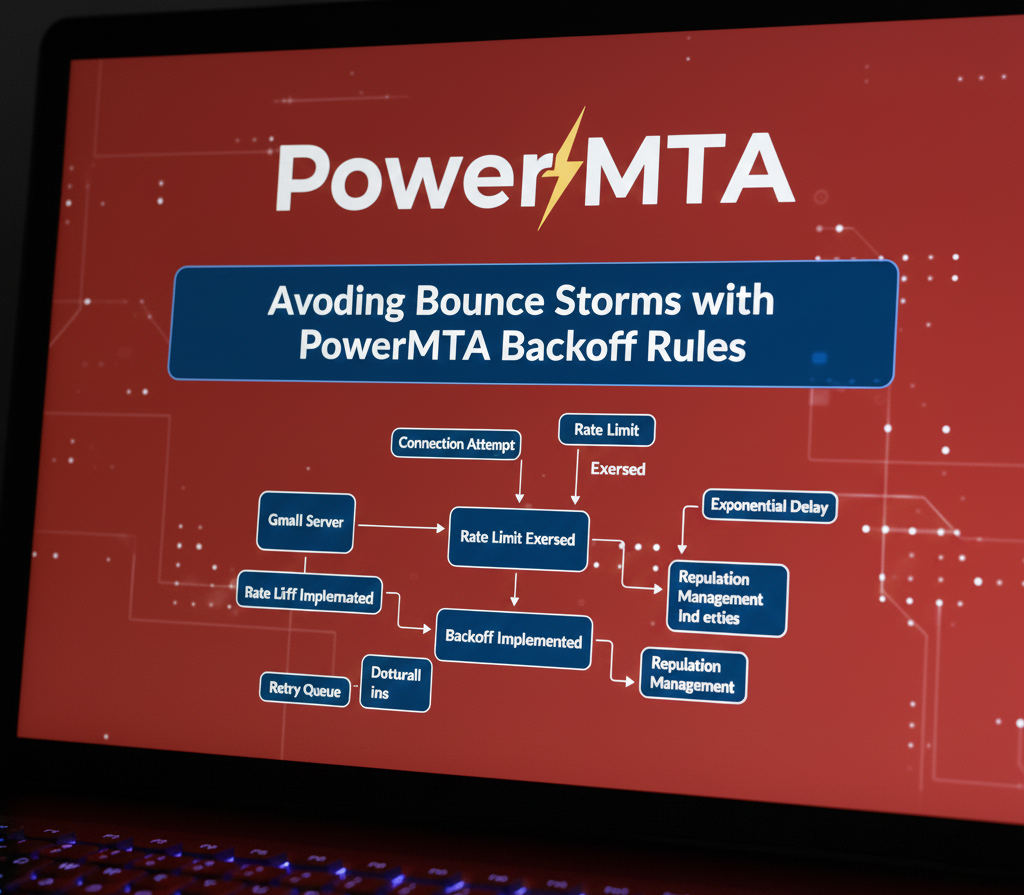 Preventing bounce storms with controlled retries
Bounce storms are one of the fastest ways to destroy an IP’s sending reputation. In high-volume environments, even a short burst of repeated failures can trigger aggressive ISP throttling or long-term blocking.
PowerMTA’s backoff system exists specifically to prevent this scenario — but only when it is configured correctly. See our detailed guide on PowerMTA backoff settings for Gmail and major ISPs.
This guide explains how to avoid bounce storms with PowerMTA backoff rules, how ISPs interpret repeated failures, and how to tune backoff for long-term deliverability protection.
What Is a Bounce Storm?
A bounce storm occurs when a mail server repeatedly attempts delivery to destinations that are actively rejecting traffic.
Typical causes include:
- Sending to disabled or blocked domains
- Ignoring 4xx deferral signals
- Excessive retries in a short time window
- Poorly scoped retry and backoff rules
From an ISP perspective, bounce storms look like abusive behavior — even when the sender’s intent is legitimate. Understanding SMTP error code classifications is essential to avoid misinterpretation.
How ISPs Detect Bounce Storm Behavior
ISPs track failure patterns, not individual messages.
Signals that indicate a bounce storm include:
- High failure density per IP
- Rapid repeat connections after deferral
- Consistent 4xx or 5xx responses
- Lack of adaptive send-rate reduction
Repeated failures without slowdown are interpreted as persistence, not resilience.
This behavior often results in ISP throttling and rate limiting.
How PowerMTA Backoff Prevents Bounce Storms
PowerMTA backoff dynamically reduces delivery pressure when failure thresholds are crossed.
Properly configured backoff:
- Slows retry attempts automatically
- Reduces concurrent connections
- Spaces delivery attempts over time
- Allows ISP blocks to cool down
This transforms repeated failures into controlled retries. Review our PowerMTA retry and backoff configuration guide for implementation details.
Designing Effective Backoff Rules
Backoff rules must be specific, not global.
Best practice rule characteristics:
- Scoped by domain or MX
- Triggered by error rate thresholds
- Progressive (not binary)
- Automatically recoverable
Overly aggressive or vague rules often cause more harm than good. Consider isolating traffic using PowerMTA virtual MTAs (vMTAs).
Handling 4xx vs 5xx Errors Correctly
Not all bounces require the same response.
- 4xx (temporary): Trigger backoff and extended retries
- 5xx (permanent): Suppress retries and clean lists
Treating temporary failures as permanent — or vice versa — is a common cause of bounce amplification. If you're seeing Gmail-specific deferrals, review how to fix Gmail 421 4.7.0 errors.
Common Backoff Misconfigurations
- Retry intervals that are too short
- No maximum retry duration
- Global backoff instead of per-domain
- Ignoring failure rate trends
These mistakes allow failures to cascade rapidly.
Monitoring for Early Warning Signs
Bounce storms rarely happen instantly.
Warning indicators include:
- Sudden spikes in 4xx responses
- Growing deferred queues
- Declining delivery velocity
- ISP-specific failure clustering
Early intervention requires structured deliverability monitoring.
Backoff Best Practices for High-Volume Senders
- Let PowerMTA manage adaptive retries
- Use conservative initial retry timing
- Segment traffic by domain and reputation
- Review logs daily for failure patterns
Backoff is a safety system — not a performance limiter. It works best alongside high-volume email best practices.
Final Thoughts
Bounce storms are preventable with disciplined backoff configuration.
PowerMTA’s strength lies in its ability to slow down intelligently, protecting both throughput and long-term sender reputation.
Proper backoff rules turn delivery failures into manageable signals — not catastrophic events. Continue optimizing with our PowerMTA deliverability optimization guide.
Frequently Asked Questions
What is a bounce storm?
A bounce storm occurs when large volumes of email are repeatedly rejected in a short period, overwhelming systems and harming reputation.
How does PowerMTA prevent bounce storms?
PowerMTA uses backoff rules and retry logic to slow sending after errors, preventing repeated rejections.
Are bounce storms recoverable?
Yes, but recovery can take time. Proper backoff and controlled retries minimize damage and speed recovery.